F
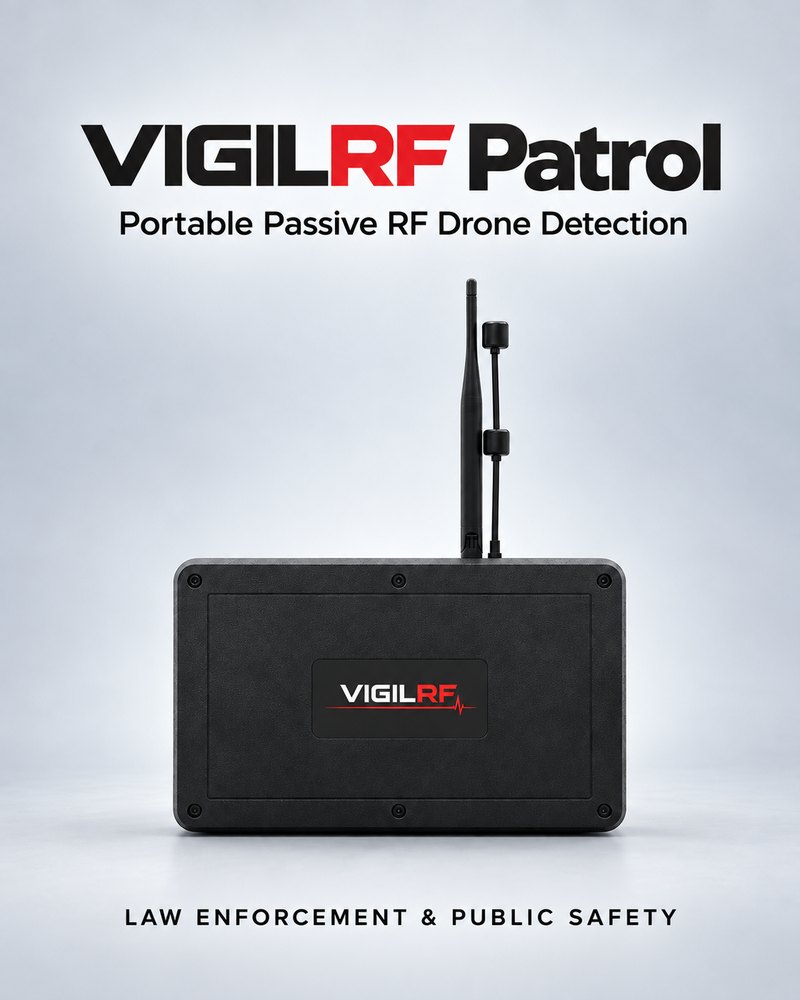
VigilRF is a passive RF drone detection system built to detect drone activity earlier and improve situational awareness, giving you more time to respond. Compact enough to be worn or vehicle mounted, affordable enough to deploy in numbers, and built to stand alone or serve as a redundancy layer alongside a full C-UAS program.
Reply within 24 hours, guaranteed.
This live demo is driven by real drone detection data captured during field testing — not synthetic placeholder data.
Drones are small, fast, and cheap. Most have no systematic way to know a drone is present until someone physically sees it — often after it's already over a restricted area. VigilRF is a practical, rapidly deployable first layer of passive RF drone detection that closes the gap between no awareness and a full C-UAS program.
Sound like a problem at your site? Let's find out for sure.
Let's Talk → Reply within 24 hours, guaranteed.VigilRF runs a continuous passive RF monitoring process — from spectrum scanning through alert delivery — with no manual tuning required.
VigilRF continuously monitors the RF bands drones rely on, with Remote ID (RID) broadcasts as a second layer of detection. It listens entirely passively — capturing activity across these frequencies with no signal interference of any kind.
Every captured signal is run against known drone RF profiles and judged on its pattern and spectral fingerprint — consumer, FPV, and homemade alike — with a pipeline tuned to suppress false positives and surface only what matters.
When the system identifies likely drone activity, it generates a real-time alert on the live dashboard with relevant signal details. All activity — alerts, baselines, and session data — is logged automatically for after-action reporting.
VigilRF can surface likely drone activity before visual confirmation, giving you more time to assess the situation and coordinate a response.
Entirely receive-only — no jamming, and no interference with any signal or device. Safe to deploy at public events, near airports, and at sensitive facilities without regulatory concern.
A live interface that shows alert status, signal activity, GPS position, and session data at a glance. Designed to be useful immediately — typical training time is under 30 minutes.
Every detection is logged with a timestamp and supporting RF details. After monitoring, you receive a documented summary of what was observed — ready for review, incident reporting, or follow-up.
Alerts can feed directly into an existing C-UAS platform, command center software, or security stack through open API endpoints. VigilRF works as the detection layer that cues the rest of your system.
The full system runs from a compact, self-contained case — worn, mounted on a vehicle, staged at a temporary perimeter, or set up in minutes at an event. Deploy one unit standalone, or several across a site for wider coverage.
Drone detection for stadiums, festivals, and venues where crowds and tight schedules make early warning matter.
Passive drone monitoring for airports, power plants, data centers, and other high-consequence sites.
Built for correctional facilities — detect contraband drops and document RF activity to support interdiction. Also a strong fit for local police operations and as a command center addition.
Drone detection for ports, terminals, cruise ships, yachts, and operations on shore or at sea.
Drone monitoring for corporate campuses, healthcare facilities, schools, and other private operations.
Discreet drone detection for executive protection, private estates, and protective security details.
Don't see your exact site? Reach out anyway — we cover more than fits in a grid.
Let's Talk → Reply within 24 hours, guaranteed.VigilRF works as a standalone first layer of drone detection — or as a redundancy layer inside a full C-UAS program.
If the primary system goes down mid-event, or is being transported between sites, VigilRF keeps passive detection running. And because each unit is self-contained, it doubles as an emergency backup: a power or network failure at the main system doesn't take drone awareness down with it.
| Approach | Best For | Key Limitation | What VigilRF Adds |
|---|---|---|---|
| Remote ID Receivers | Tracking compliant drones that broadcast standard Remote ID signals | Non-compliant, modified, or intentionally evasive drones — including FPV and homemade builds — do not broadcast. Threat actors are unlikely to announce themselves. | Passive RF monitoring of drone control links is VigilRF's primary detection method — surfacing activity regardless of whether the drone broadcasts Remote ID. Remote ID is also used as a secondary detection layer when broadcast. |
| Cameras / Radar | Visual confirmation and tracking once a drone is airborne and within range | Cameras require line of sight and adequate lighting. Radar is expensive and prone to false positives from birds and clutter. Both require the drone to already be airborne and in sensor range. | Drone control links are often active before the drone enters camera or radar range. Passive RF monitoring can provide earlier warning, giving you more time to direct a response. |
| Full C-UAS Suites | Organizations with authority, budget, and personnel for active countermeasures such as jamming or kinetic response | Six- to seven-figure cost. Federal authorization typically required. Long procurement cycles. Complex to operate and maintain. | For organizations that cannot legally jam or defeat drones, VigilRF provides passive RF drone detection at a fraction of the cost. For those with full suites, it can serve as an additional RF sensor redundancy layer. |
Fill out the form and we'll write back within 24 hours.
Just exploring? Ask anything — no commitment.
Based in Maryland or the DMV area? We're local. We'd especially like to hear from you.
Prefer email? Write directly: colin@vigilrf.com